
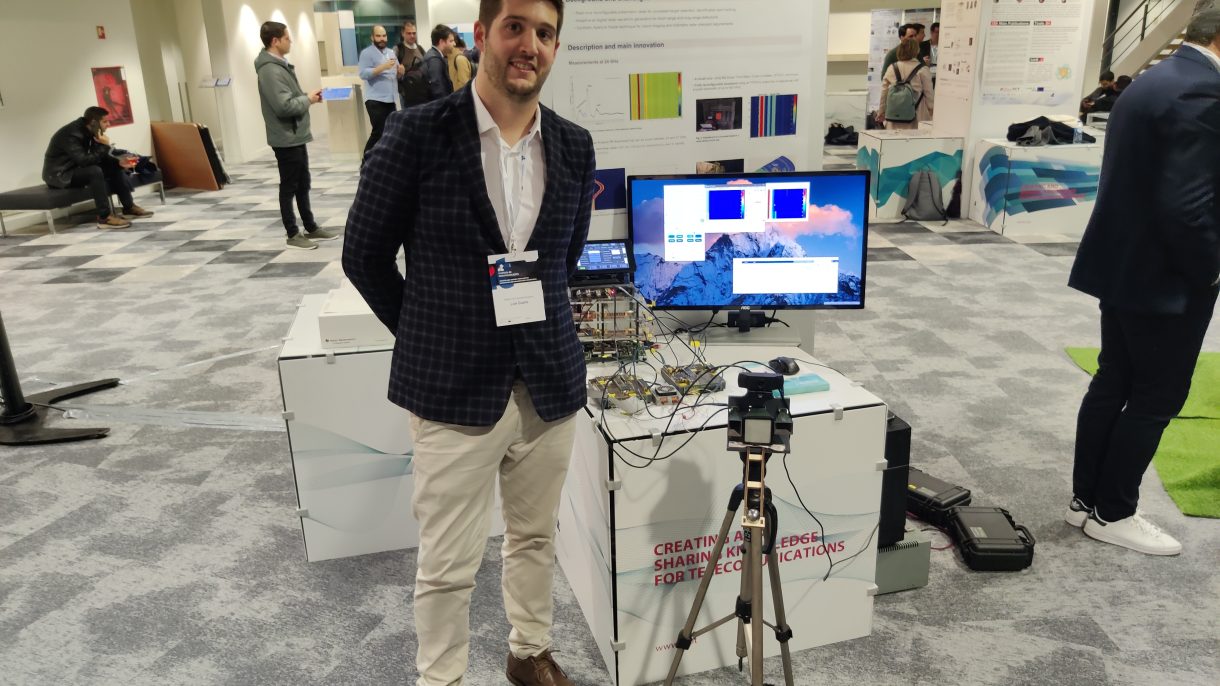

This PhD work’s main objective is to accomplish a dual-polarisation STDCC radar with fully reconfigurable capabilities. It explores the auto-correlation properties of PN sequences to detect targets taking advantage of their high immunity to interference characteristics.
This novel radar uses the Swept Time-Delay Cross-Correlator (STDCC) technique that presents high-resolution and multi-user operation with its good interference immunity.
STDCC reconfigurable baseband:
A key part of this thesis was the development of a radar baseband with fast prototyping capability to improve radar detection performance on the fly. Thus, an agile radar baseband is required to generate radar waveforms and tune them, allowing to study of Key Performance Indicators (KPI) for different radar waveforms. The proposed reconfigurable baseband architecture, depicted below, uses an FPGA to change, on-the-fly, the all-digitally outputted PN sequences and their bandwidth.

mmWave reconfigurable RF front-end operating between 24 and 28GHz:
The 24GHz band has a license-free band of 250MHz bandwidth that was widely used in the last decade in radio location applications, especially for short-range radar (SRR) scenarios in the automotive and drone sectors. We developed an RF stage using X-microwave technology that provides a complete modular building block eco-system for microwave components as shown in the following figure. Two transmitting and receiving RF stages operating between 24 and 28GHz were achieved in the end.

Radar App development:


A MatLab app was fully developed to automate the FPGA configuration and to visualise the radar captured data. Three different data visualisation tabs, each responsible for a different capture mode with the antennae still or moving. The user can select between a PDP that is a range profile mode with received signal strength as a function of distance, a waterfall mode, which shows the radar signal’s power spectrum as a function of time and PPI that uses motors to rotate the radar to accomplish a comprehensive view of the radar surrounding area.

SAR algorithm development:
Typical application usage for this technique is high-resolution screening and mapping of difficult access areas like heavy vegetation forests or other critical systems used in aviation systems. Using SAR algorithm we can reconstruct the intended target by performing various acquisitions with different perspectives accomplished by the radar movement as shown below.
The SAR algorithm can also improve radar spatial resolution. The STDCC radar has a maximum of 500 MHz, which corresponds to a 30 cm resolution. By using the synthetic aperture technique we can accurately reconstruct smaller targets below our resolution like is shown in the results below from a PCB that has the physical dimensions of 12x8cm with three shapes of 3 cm.
